Digital humanities · Islamic law · Southeast Asia

Convergent Scripture, Divergent Rulings

How five Southeast Asian states translate the economic Qur'an the same way — yet rule on it differently.

Working paper · under review at Studia Islamika

The question

Across Southeast Asia, rendering the Qur'an into a national language is the work of the state. This study takes the muʿāmalāt (commercial-ethics) verses and asks two things of five official editions: do their translations agree, and do the states' fatwas on the economy agree? Transposing the text-mining method of Lange et al. (2021) from classical Arabic to a multilingual corpus, it finds that the two layers come apart.

Layer 1 · Text

Translation converges

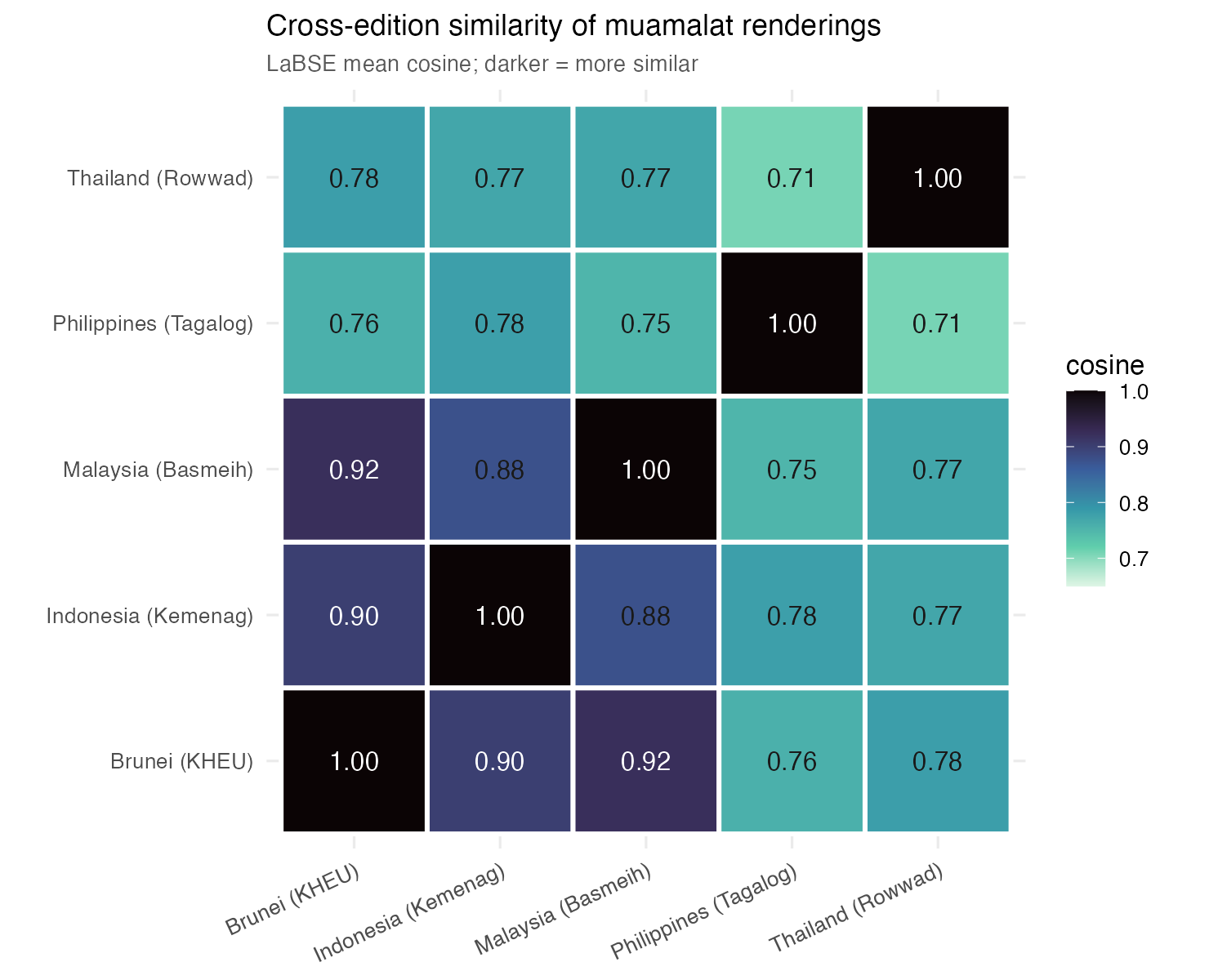
Cross-edition similarity is governed by language family. The Malay editions of Malaysia and Brunei are the most similar pair of all.

Layer 2 · Law

Fatwa diverges

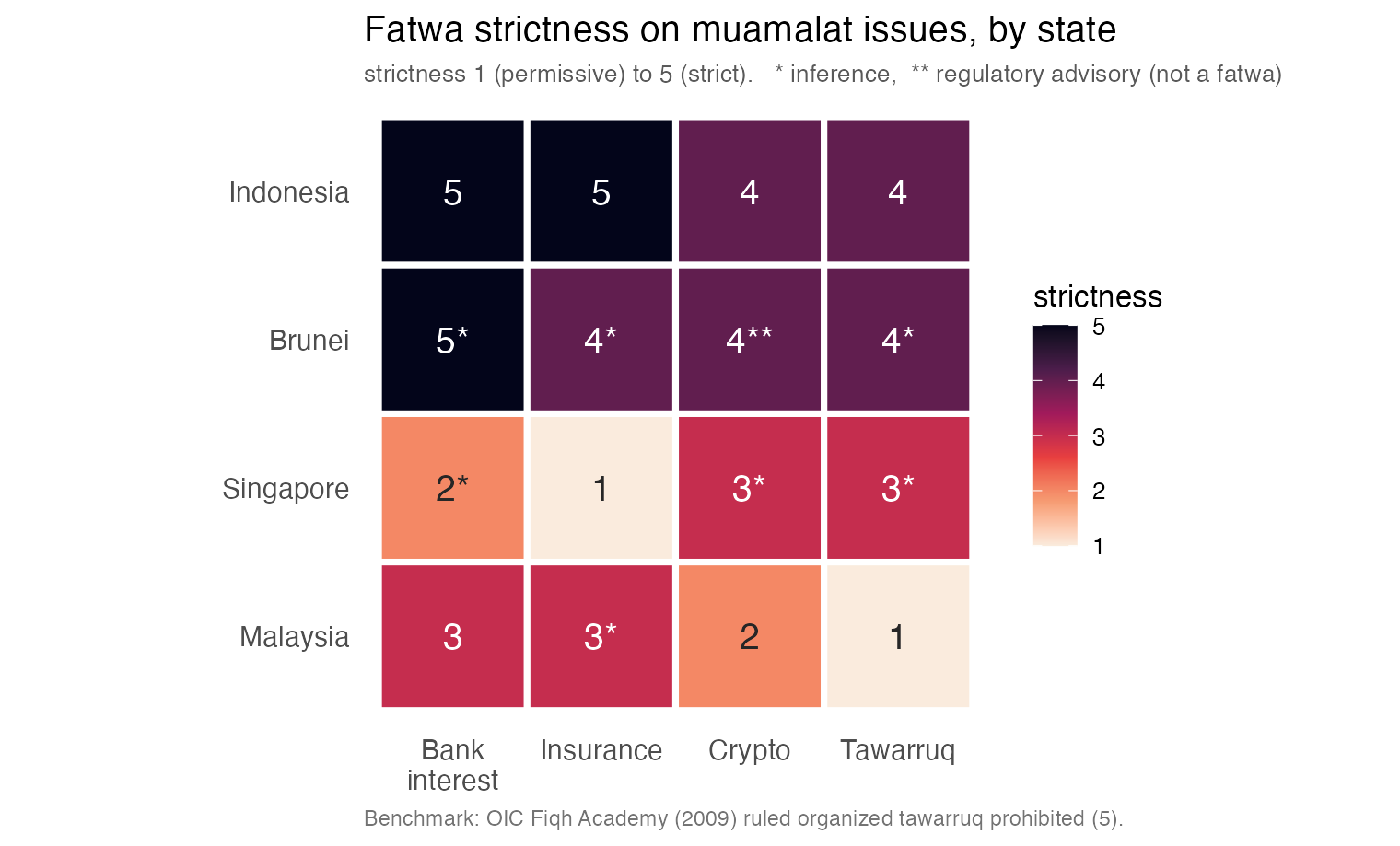
On bank interest, insurance, crypto, and tawarruq the same states run from most to least permissive: Malaysia, Singapore, Brunei, Indonesia.

The result

The layers decouple

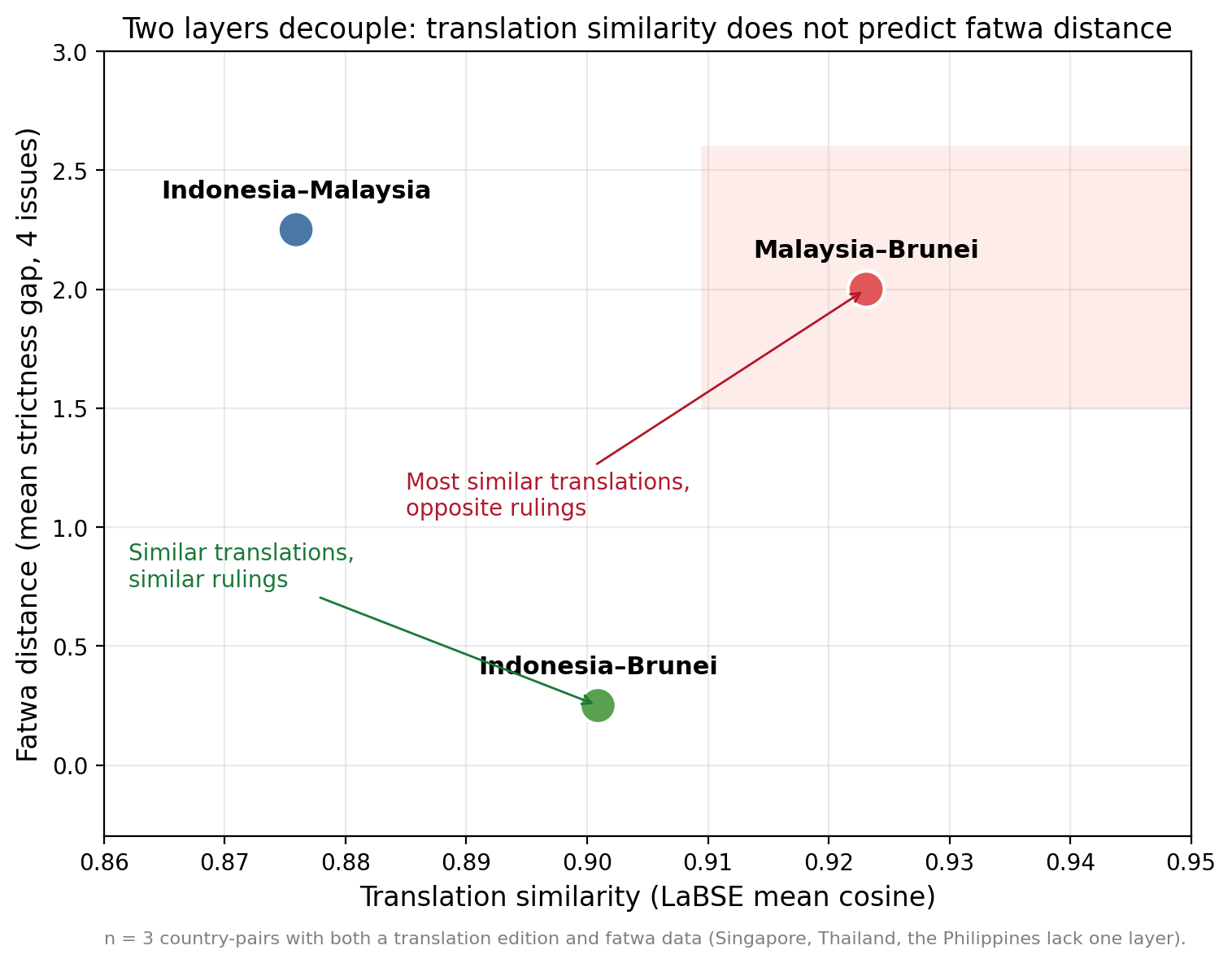
The most textually similar pair, Malaysia–Brunei, anchors opposite ends of the ruling spectrum. The translation does not predict the fatwa.

The argument in one figure

One shared Arabic text runs through tafsir and translation into juristic reasoning and, finally, a fatwa. The study measures the two ends — translation and fatwa — and treats the juristic middle as the mechanism that lets one text yield divergent rulings.
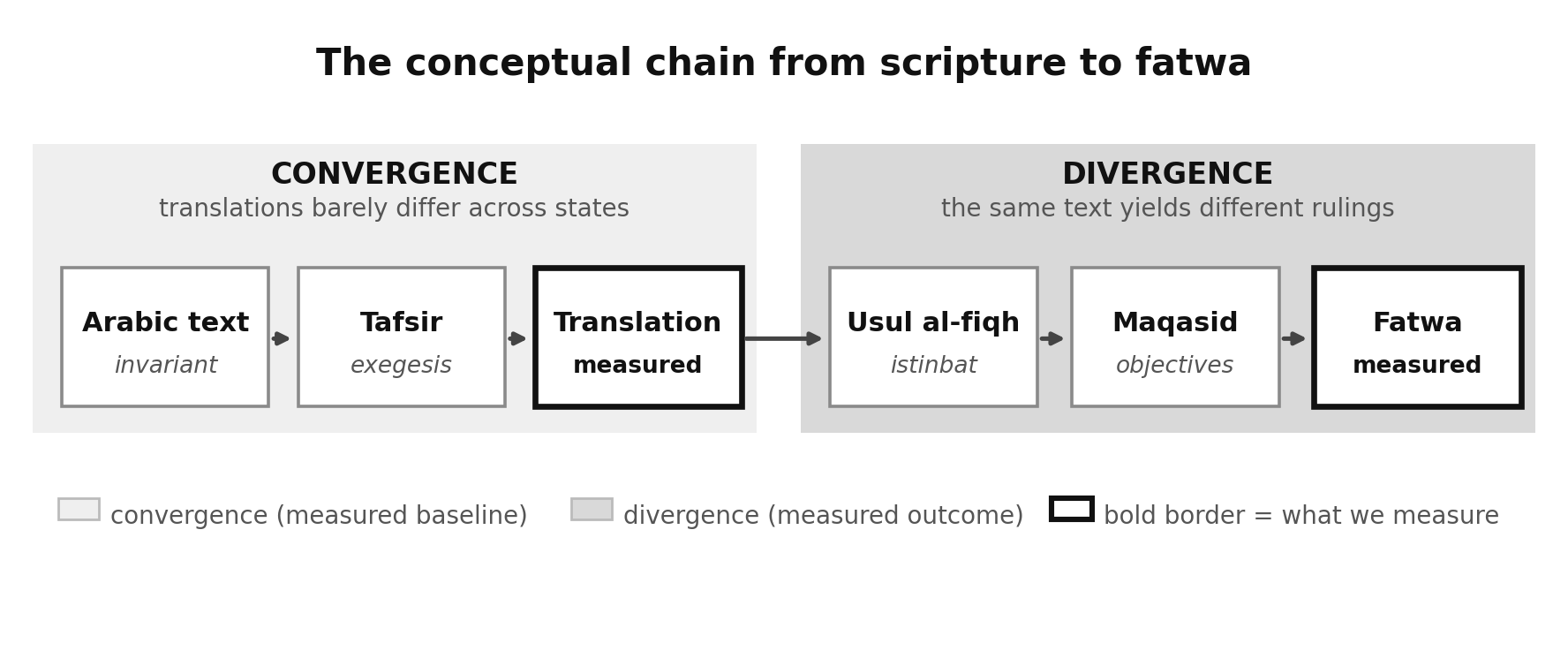
Conceptual chain from scripture to fatwa
The conceptual chain. Left = convergence (translations barely differ); right = divergence (the same text yields different rulings). Bold borders mark what the study measures.

By the numbers

105anchor verses × 5 editions
0.92Malaysia–Brunei similarity (highest)
20muʿāmalāt domains
p < 10⁻¹⁸within-family > cross-family

What the data shows

Every rendering is embedded with LaBSE, a model that places sentences from different languages in one comparable space; similarity is the cosine between editions, averaged over verses.

Cross-edition similarity heatmap
Translation layer. Cross-edition similarity of muʿāmalāt renderings (mean cosine). The three Malay-family editions cluster tightly; Malaysia–Brunei is the closest pair.
Fatwa strictness heatmap by state
Fatwa layer. Strictness of each state's rulings on four muʿāmalāt issues (1 permissive – 5 strict). Indonesia and Brunei are strictest; Malaysia most permissive.
Two-layer decoupling scatter plot
The two layers decouple. Translation similarity (x) does not predict fatwa distance (y): the most similar pair, Malaysia–Brunei, sits at opposite ends of the ruling spectrum.
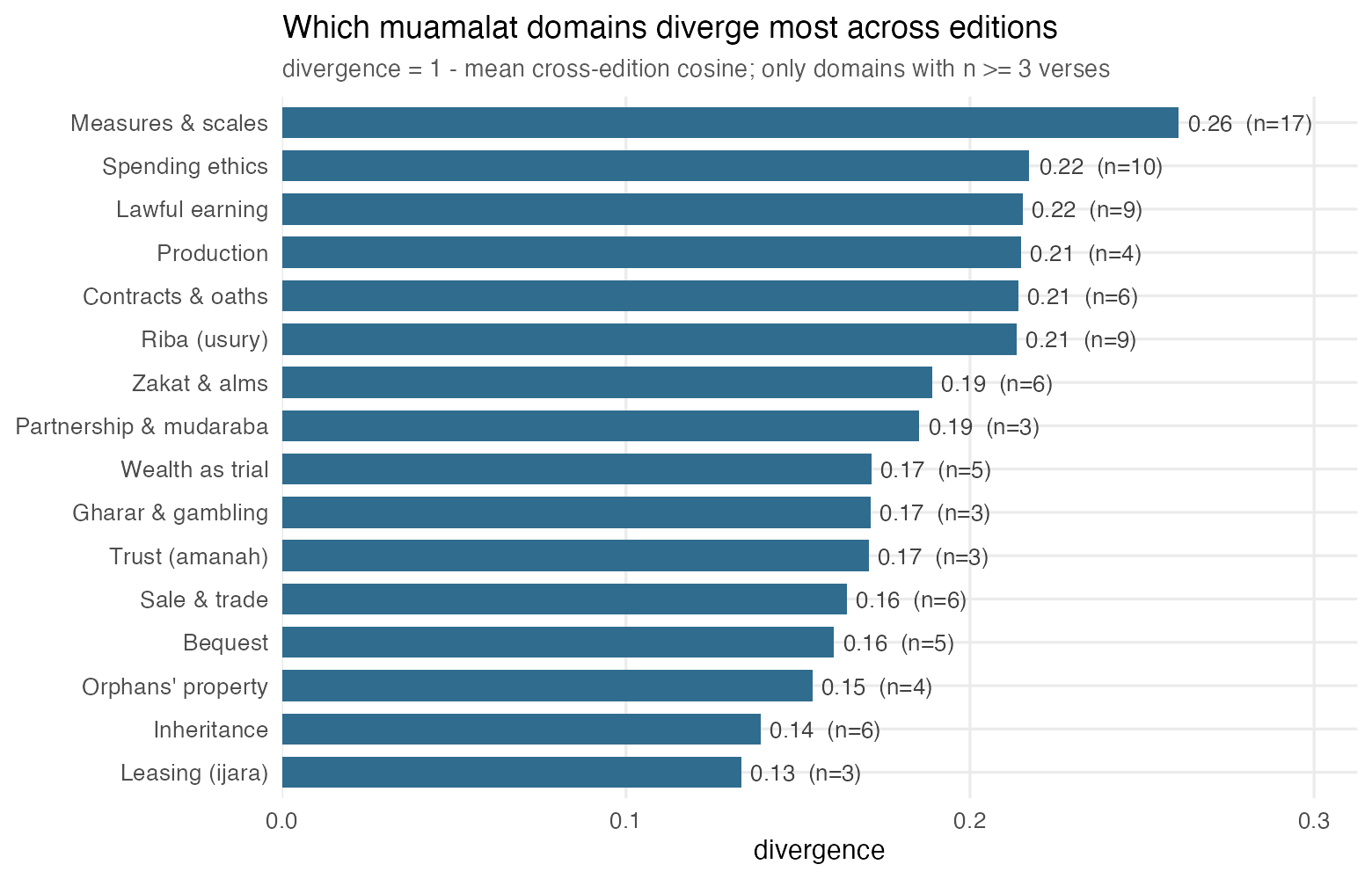
Divergence by muamalat domain
Where editions disagree. Divergence = 1 − mean cross-edition cosine, by domain. Measures & scales admit the most interpretive spread; inheritance the least.

Reproduce it yourself

Everything behind the paper — corpus, code, cached embeddings — is open. A single notebook recomputes the similarity matrix, re-runs the statistical tests, and plots the decoupling, from committed data with no model download.

git clone https://github.com/DzakiDU/convergent-scripture
cd convergent-scripture
pip install -r requirements.txt
jupyter notebook notebooks/reproduce_analysis.ipynb